
Water softener salt
Which is better: a water softener with or without salt?
In short, a salt-based water softener is better. This is because it is the only type of water softener that actually removes all the limescale from tap water. As a result, you will no longer experience any of the problems caused by limescale build-up. All other water softeners (such as, for example, magnetic water softeners) attempt to neutralise the limescale, but the effect is minimal.
How does a salt-based water softener work?
A water softener removes this limescale from your tap water, thereby preventing limescale.
The removing the limescale present This is what happens to the resin in the water softener. These tiny, rock-hard resin beads are able to bind with limescale, thereby turning hard water into soft water. They do this through a process known as ion exchange.
Over time, the synthetic resin beads become saturated (filled with calcium and magnesium particles) and are no longer able to bind limescale. To prevent this from happening, the resin beads must be cleaned from time to time. This is done by flushing them (a process known as regeneration) with salt water. This salt water is then drained away.
So the salt does not remove the limescale from your tap water. This is done by the resin inside the cylinder of the water softener.
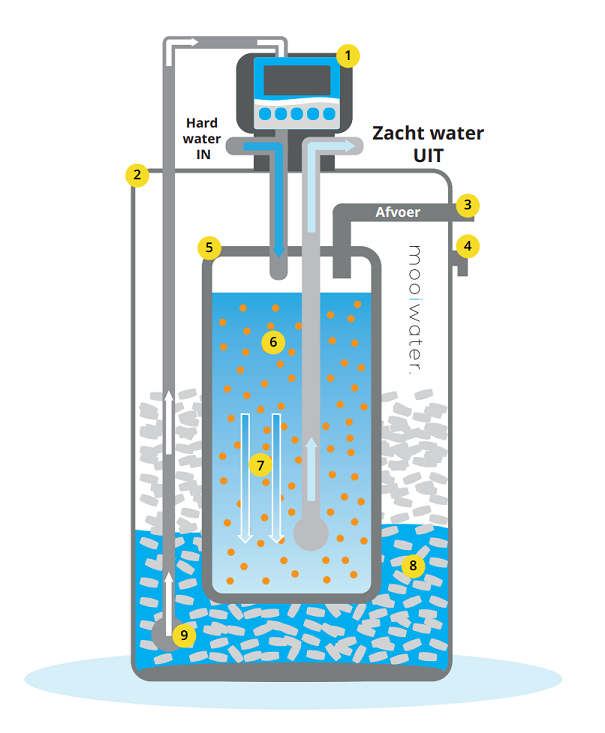
1. The control unit ensures that your system operates at its best.
2. You can top up the salt via a filling opening on top of the salt container.
3. When the system flushes, the flush water is discharged via a drain into the sewer.
4. The overflow ensures that excess water is drained into the sewer.
5. The tank in the system contains resin beads to which the limescale adheres.
6. Over time, the resin pellets become saturated with lime. Rinsing them with brine removes the lime particles
removed and the resin is cleaned again.
7. The arrows indicate the direction of water flow (downflow).
8. The salt container holds salt tablets used to make brine. This brine is used to clean the resin.
9. The brine is drawn up through a pipe and pumped through the resin tank to rinse the resin beads.
How much does a salt-based water softener cost?
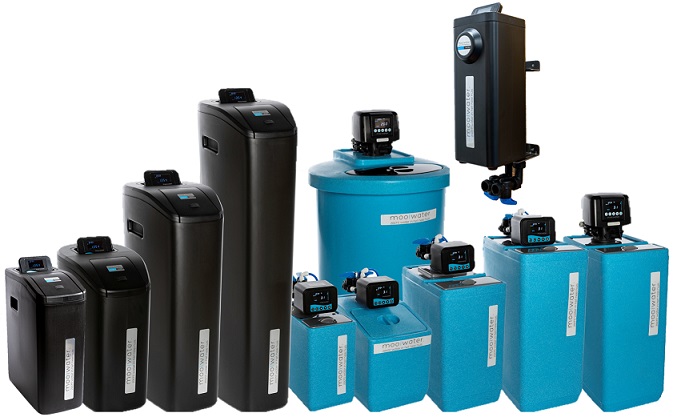
The cost of a salt-based water softener depends on the type of softener you choose and the features you want it to have. This also depends on your budget and water consumption. On the ‘Buying a water softener‘We have compiled a list of the various water softeners and their prices for you.’.
See also: Water softener prices and models
What sort of salt is used in a water softener?
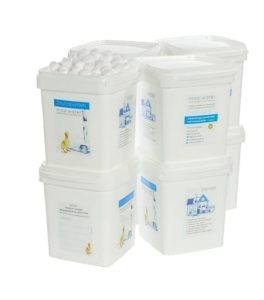
Pure salt is essential for a descaler to work effectively. We supply water softening salt (NaCl) with a purity of at least 99.9%. Our salt is suitable for all types of water softeners. To ensure our operations are as sustainable and environmentally friendly as possible, we supply the salt in reusable buckets.
Usage Never use table salt in your descaler. This salt is not pure enough and therefore causes contamination. After a while, it starts to clump and build up, which is very bad for your water softener. You should therefore only use high-quality vacuum salt tablets in your descaler. The purity of our tablets is always at least 99.9%. This ensures that your ‘Mooiwater’ water softener will have a very long service life of at least 20 years. It also means we comply with European standards for water softening salt for domestic use.
You can order the water softening salt very easily from our online shop.
What is water softening salt?
Water softening salt, regeneration salt Does water softener salt clean the resin of water softeners. So the salt does not remove the limescale from your tap water. This is done by the resin inside the water softener’s cylinder. This resin gradually becomes saturated with limescale particles, as they bind to the resin. The softening salt forms brine, which rinses the resin cylinders clean, allowing the resin to effortlessly remove the limescale from your water once again.
Quality standards for salt-based water softeners
The Mooiwater water softener salt tablets are of a very high quality and the highest purity. Our regeneration salt has a NaCl content of at least 99.9% and complies with the EN 973 Type A and DIN 19604 quality standards for salt. Thanks to their specific composition, the tablets dissolve very evenly and do not clump. Click here to order salt tablets for your water softener.
Is water softening salt suitable for human consumption?
Our water softening salt is, in fact, very pure salt, free from all possible impurities and therefore perfectly suitable for consumption. It is salt in its purest form. It has been specially purified to ensure that your water softener can operate trouble-free for years without the salt leaving any residue in your equipment or clumping together. This could lead to malfunctions, which we would like to avoid.
Is using salt bad for the environment?
A water softener is good for the environment because it significantly reduces the use of detergents, cleaning products and personal care products, and even cuts the use of descaling agents down to zero! In addition, using a water softener improves the efficiency of heating elements in Quookers, kettles, boilers, etc.
It is true, however, that a proper water softener uses salt. Salt itself is not harmful to the environment. In an average winter, around 100 million kilos of road salt ends up on the streets, and even such quantities do not cause environmental problems. Nevertheless, we want to minimise salt consumption as much as possible; this is good for your wallet and for the environment. After all, whatever is added to the water must also be removed by the water company. That is why our Mooiwater water softeners the most economical ones available. An average family uses between 50 and 75 kilos of salt a year.
Environmentally friendly
As we operate a deposit scheme for the buckets, we’re also helping to protect the environment. We charge a €4 deposit to encourage recycling. When you place a new order (for at least eight salt buckets), you can exchange the empty buckets for full ones and pay only for the salt. Find out why using water softeners is sustainable.
How much water softening salt do I need?
With a single 12.5 kg bucket of salt, your Mooiwater water softener can soften at least 25 m³ of water. This is equivalent to 25,000 litres of water. For an average household, this is enough to soften water for two months. At this rate of consumption, you will therefore need six buckets per year.
Order water softening salt
Would you like to order water softener salt? It’s very easily in our online shop. We supply our salt in 12.5 kg buckets. We believe that lugging around 25 kg bags of salt is too much of a burden for you, the consumer, and for the person delivering it. The buckets are designed so that they stand at an angle when pouring, making it easier to top up.
If you order 8 buckets or more, you won’t be charged for delivery. You can also collect the buckets from our branch at Dronten (De Gouwe 49).
Click here to order salt for your water softener
Have you made a decision yet?
Why not request a free, no-obligation quote?
Do you have any questions?
We’re here to answer any questions you may have!
Have you made a decision yet?
Why not request a free, no-obligation quote?
Running costs
Compare
Overview of water softeners
Placement
Water hardness
Facts and myths