
What is water hardness?
Water hardness indicates the concentration of calcium and magnesium particles in tap water. Water hardness is therefore measured by the amount of calcium and magnesium in the water. The more calcium and magnesium there is in the water, the ‘harder’ the water.
Water hardness by municipality
Water hardness varies across the Netherlands. Select your local authority and find out how hard the water is in your area.
Water hardness in the Netherlands
Water hardness in the Netherlands is expressed in German degrees (°dH). This indicates the amount of calcium carbonate in our water. 1°dH means that there are 17.8 grams of calcium carbonate per 1,000 litres of water. With an average water hardness of 8°dH and an annual water consumption of 150m3, this means you’ll end up with one kilogram of limescale in your pipes every two weeks. So the higher the °dH value, the more calcium there is in the water.
Want to test your water hardness yourself?
You can also test the water hardness of your tap water very easily yourself. With a simple test kit, you can measure for yourself how hard the water coming out of your taps is.
In our online shop You can order a water hardness test kit and find out for yourself how much limescale is in your tap water.
Water hardness by municipality or place of residence
The average water hardness in the Netherlands is 8°dH. However, water hardness varies from one municipality or place of residence to another. The variation in water hardness is due to the many different sources from which the water is supplied.
Would you like to know how much calcium is in your local tap water? You can find out. Click on your town or village name to see the water hardness. (Check here to find out the water hardness for your postcode)
Is your local authority not listed here? Find out the water hardness for your local authority here
Water hardness in my local authority area
How hard is my water?
The table below explains what the different German hardness levels mean. Find out how hard your water is, the extent of limescale build-up, and the concentration of salts (calcium and magnesium) in your tap water.
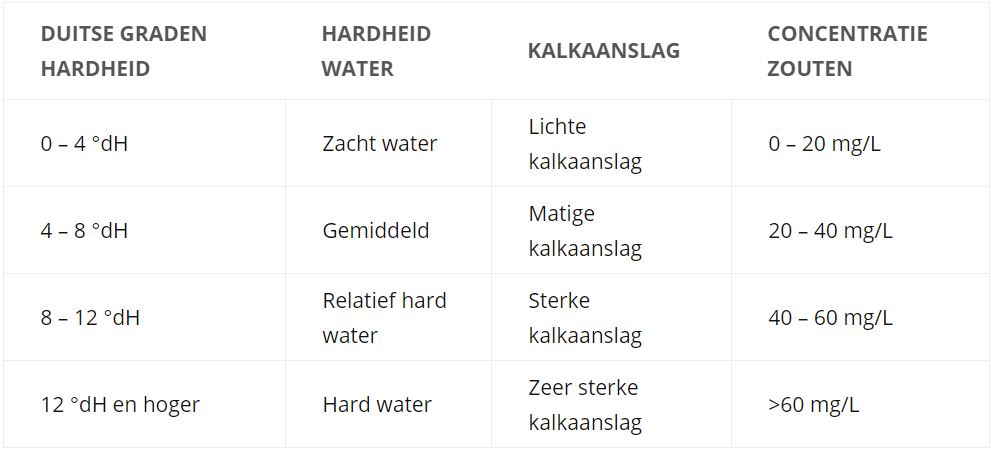
There are also test strips which you can use to measure the hardness of the water. These strips are readily available. Hold the test strip in the water for a few seconds and, after a minute, you can tell the water hardness from the colour of the strip.
What are the effects of hard water?
The harder and warmer the water, the faster limescale builds up. You can recognise limescale by the white patches it leaves. Limescale build-up is common in washing machines, showers and kitchen appliances. A chemical reaction occurs between limescale particles and detergents, meaning you need to use more washing powder than usual. What’s more, limescale has a negative impact on hygiene in your home. This is because bacteria and mould are more likely to develop on surfaces with limescale build-up. Special limescale removers are needed to remove the limescale. Over the course of a year, this costs a lot of time and money. So it’s no wonder that more and more people are opting for a water softener. With a water softener, you’ll have 100% soft water.
Water softening
Do you live in a municipality with hard water? If so, you can Buy a water softener from Mooiwater, which softens your water. There are many benefits to softening water. Soft water prevents limescale build-up and can save you up to €500 a year. What’s more, our 100% water softeners are efficient, meaning you use very little water softening salt consumed.
Do you have any questions?
We’re here to answer any questions you may have!
Have you made a decision yet?
Why not request a free, no-obligation quote?
Running costs
Compare
Overview of water softeners
Placement
Water hardness
Facts and myths