
When is a water softener needed?
Do I need a water softener?
When you talk about water softeners, a common comment is: ‘But we don’t need water softeners in the Netherlands, do we?’ It’s true that we in the Netherlands may well have the best tap water in the world. However, that doesn’t mean you don’t limescale experiences. How does that work?
To answer that question, we must first explain what water hardness . Water hardness indicates the concentration of calcium particles in tap water. Water hardness is therefore measured on the basis of the amount of calcium and magnesium in the water. The more calcium there is in the water, the ‘harder’ the water.
As the average water hardness is much higher in some European countries, water is only referred to as ‘very hard’ when its hardness exceeds 30dH. A hardness of 8dH – which is the average water hardness in the Netherlands – is therefore not too bad and falls into the ‘moderately soft’ category. You might think that a water softener is therefore unnecessary in the Netherlands because we have, on average, soft water. We would like to correct that perception.
Add 1 kilo of lime to your water every 2 weeks
A hardness of 1°dH means that there are 17.8 grams of limescale per 1,000 litres of water. With an average water hardness of 8°dH and an annual water consumption of 150m³, this means you’ll have one kilogram of limescale in your pipes every two weeks! The conclusion is that, whilst there is certainly not nearly as much calcium in tap water in the Netherlands as in some other countries, it is by no means surprising that you are experiencing limescale problems in your existing or new-build home.
What are the effects of hard water?
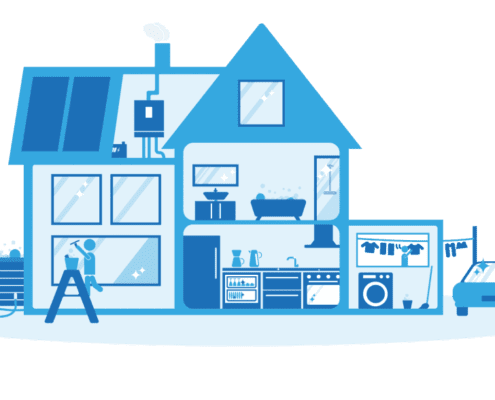
The harder and warmer the water, the faster limescale builds up. You can recognise limescale by the white patches it leaves. Limescale build-up is common in washing machines, showers and kitchen appliances. A chemical reaction occurs between limescale particles and detergents, which means you’ll need to use more washing powder than usual. What’s more, limescale has a negative impact on hygiene in your home. This is because bacteria and mould are more likely to grow on surfaces with limescale build-up. Special limescale removers are needed to remove the limescale. Over the course of a year, this costs you a lot of time and money.
Water softening
Hard water can easily be softened using a water softener from Mooiwater. There are lots of benefits water softening. Soft water prevents limescale build-up and can save you up to €500 a year. What’s more, our 100% water softeners are efficient, meaning you use very little softening salt.
How exactly does it work?
A water softener removes this limescale from your tap water, thereby preventing limescale build-up.
Want to find out more?
Do you have any questions about our services or water softeners? Please feel free to contact Please get in touch with us. We’d be happy to help.
Do you have any questions?
We’re here to answer any questions you may have!
🔴 We are currently unavailable by telephone. However, you can always send a email Send!
Have you made a decision yet?
Why not request a free, no-obligation quote?
Running costs
Compare
Overview of water softeners
Placement
Water hardness
Facts and myths