
Volume-controlled water softener
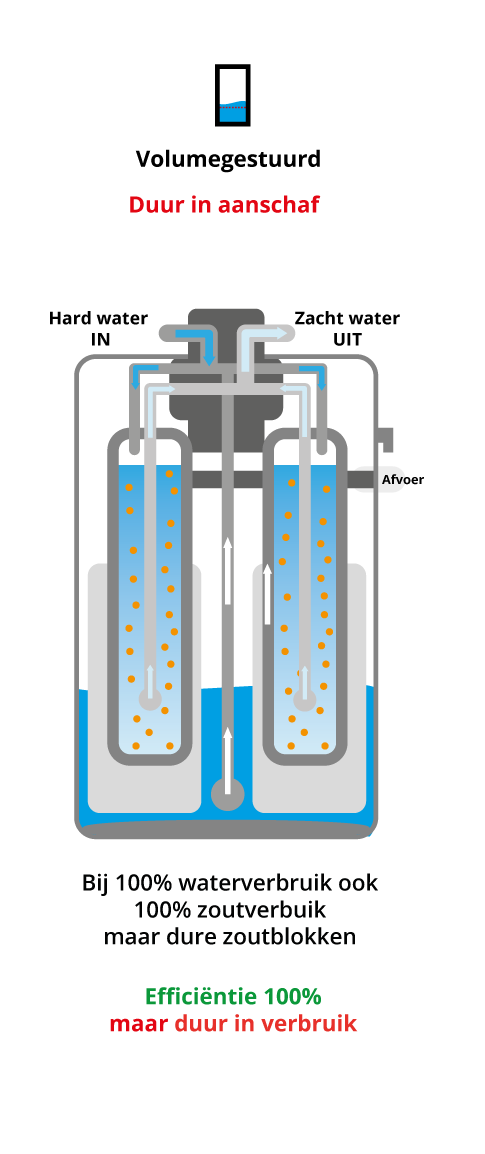
In the case of a volume-controlled water softener The system will rinse when the calculated capacity has been fully used up. The water softener does this by constantly measuring the volume of water passing through it. Rinsing will only take place once the water softener’s capacity has been fully utilised. This is a highly efficient but expensive technique.
This is because backwashing can take place at any time of the day, including at times when water consumption is high. With just one resin tank, the water softener would not produce limescale-free water whilst backwashing is taking place. That is why two resin tanks are required (duplex), which is costly. It should also be borne in mind that, during backwashing, one resin tank does not produce soft water and so there is temporarily less softening capacity available. Resin cylinders are also very small and therefore contain little resin, which leads to very frequent backwashing (usually less than 1,000 litres until the next backwash cycle).
These systems also often use expensive salt blocks that are only available from the water softener supplier. Unlike all other water softeners, this type operates solely on water pressure. The advantage of this is that no electricity connection is required and it consumes no electricity. However, with non-electric water softeners, electricity consumption is limited to less than €2 (less than 10 kWh) per year. The disadvantage of operating without electricity is that, in the event of a prolonged absence – for example, due to a holiday – the water softener will not be flushed. After all, there is no water consumption. This can lead to unwanted bacterial growth. This is prevented by the other technologies: time-controlled water softeners are flushed at fixed times, whilst with the combined time- and volume-controlled systems, a so-called ‘holiday mode’ can be programmed into the control unit.
In short: It is efficient but expensive to buy and costly to run due to the special salt blocks. Furthermore, whilst the system does not require electricity, this also makes it more susceptible to bacteria.
Alternative: a Mooiwater water softener which works much more efficiently and can save you a lot of money!
Do you have any questions?
We’re here to answer any questions you may have!
Have you made a decision yet?
Why not request a free, no-obligation quote?
Running costs
Compare
Overview of water softeners
Placement
Water hardness
Facts and myths