
What is a traditional time- and flow-controlled water softener?
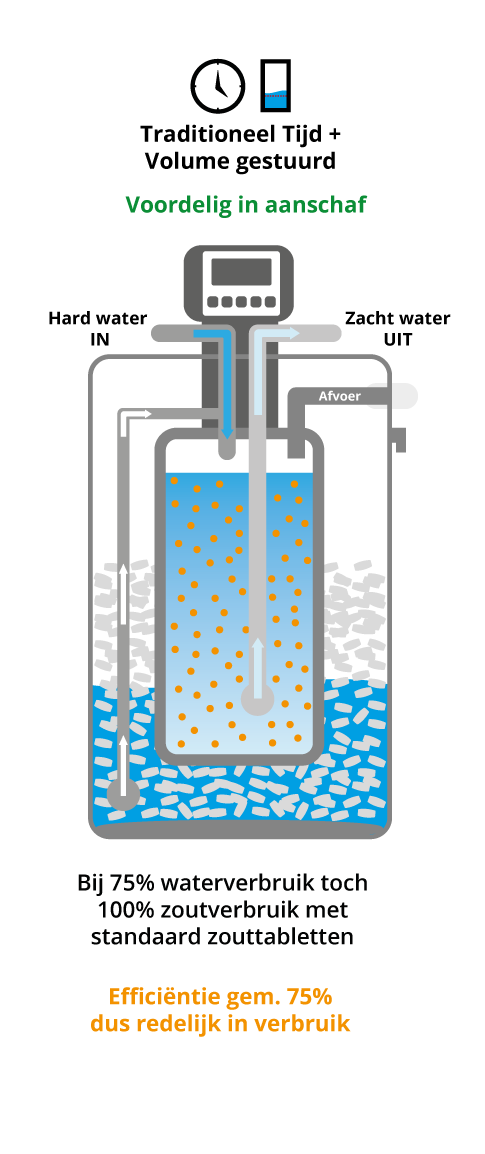
The traditional time- and volume-controlled water softener combines both of the above techniques and uses a single resin tank (simplex).
Suppose it has been calculated that the water softener can remove limescale from 4,000 litres of water and that it takes an average of 10 days to use up this amount. Once every 24 hours, the system measures how much water can still be softened – the so-called reserve capacity. As long as this reserve capacity is sufficient to cover the next 24 hours, the system takes no action. Once the calculated reserve capacity has been reached, the system will flush at the next scheduled measurement time, even if the resin’s full capacity has not yet been utilised at the time of flushing.
So, even though, for example, only 92% of the capacity has been utilised, the system will flush with 100% of salt as if 100% of the resin capacity had been used. This technique is considerably more efficient (averaging 75%) than time-controlled water softeners and more cost-effective, though less efficient than volume-controlled water softeners.
In short: cheap to buy but inefficient, and therefore less economical to run.
Alternative: a Mooiwater water softener which works much more efficiently and can save you a lot of money!
Have you made a decision yet?
Why not request a free, no-obligation quote?
Do you have any questions?
We’re here to answer any questions you may have!
Have you made a decision yet?
Why not request a free, no-obligation quote?
Running costs
Compare
Overview of water softeners
Placement
Water hardness
Facts and myths